Professional singing is not natural and it is a wearing activity, that’s why you need a technique. A technique, a good technique, will make yourself and nobody notice those two things and that’s why it is so important for singers to build a proper technique instrument, and for us the professional of voice to ajourn our tools and adjust and evolve them with the evolution of music.
Author: Lucia Cossu voice teacher
Voice teacher/ singing teacher pro/future pro all styles.
🌏online; former classical soloist, pioneering bridging biomechanics& voice practices, international presenter.
.
Italian/French voice teacher for professionals and future pro singers, innovator in vocal technique specialised in training and personalised solutions, voice development and voice preparation for touring/recording, young voices development without forcing the delicate and respectful balance of young talents. She has solved strain/issues and limitations of singers unsolvable by training or medical therapies. Those skills have 15 years of successful career and voice transformations in all styles; hospitals have sent her some desperate cases, all successfully.
Her innovative perspective has been presented at the prestigious Pan-European Voice Conference PEVoC14 2022 in one paper and two workshops and three Posters at The Voice Foundation 52nd Annual Symposium May 31- June 4 2023 in Philadelphia, where she will present again in 2024 an oral presentation and two more Posters and at PEVoC15 with another oral presentation plus two workshops.
She comes from an international soloist career in classical music that a malpractice during an abdominal surgery has interrupted (the surgeon has been convicted).
Courses and workshops are available online from everywhere and in person can be arranged.
Fundamentals Registers and passaggio
In vocal technique to solve a technical point often means to make in the perception of the singer the disappearing of the question. This is the case for the passaggi, or vocal bridges. When truly solved the mechanism to adapt gesture and postures and muscles work and copertura will make the singer never perceive that such passaggio do exist.
* This is one of the typical examples of how a technical level will give opposite perceptions, even if from a physiological level the question is the same. In a technical solved level the singer will say exactly the opposite of the not solved singer about any question.
My students: Rita Negrini
Enjoy!
Tips Copertura: everybody the same?
One of the fundamental points in technique is when and with what position making the copertura, especially related to the first turn of the larynx for the first bridge. Great part of national schools and national taste in sound is given by this position and way of making the copertura. If you prefer you can think about it as the first point in which you make the turn of the larynx, being the second the necessary one to obtain the high notes in female voices, falsetto in men and a certain kind of successive slightly turn for high notes in men voices while sustaining when it is not desired a falsetto sound.
It gives the clear and precise english sound in medium and medium high register with its quite high position and the habit of not getting below, the somewhat flatted and falsetto sound in France, the velvet and lightness of accent and high tones in the spanish due to the involvement of soft palato to obtain their copertura, the always connected to sustain and back of american school that gives more strenght to the nearly same position then english school but less poetry in the ovetornes, the low position in german school that need to put some intubation to make the turn possible and connected, the perfect balance of all these elements in Italian belcanto school, the slightly below positions of the swedish italian belcanto that gives more weight by the lower position and greater use of back diaphgragm connection, the russian school which now is the closest to the XXth century italian belcanto we have.
The first turning point can be moved and managed both by pronounciation or use of mask muscles and soft palate or internal nose muscles and the sustain and appoggio muscles and the posture in itself. It is something to think about when starting a training and also it is to have a strategy about according to repertoire and market in which the singer is working or going to work.
My students: Eleonora Braconi
Eleonora Braconi a typical example of my student after a good period together. Here 16 after 6 years of lessons.

She is 16, she studies with me since she was 10. Great personality, more jazzy than what she thinks now of herself. Here some covers and one of her compositions. Enjoy.
Basics Pressure under the glottis
The same pressure can be associated to strain or perfect phonation. There are many ways to produce the same pressure: creating it before the attack, on the attack, with a certain speed, at a precise speed and with or without suspension, with some muscles and timing and reciprocal order of movement, putting a tension in some part and then just creating a slight tension in another part to create conditions for the attack etc. Understanding this is fundamental to have a correct attack and many different ways of attacks accorded to musical and interpretative requirements.
Tips Vocal logic
For a singer or a performer it is often more effective looking for vocal solutions thinking in a way that has a vocal logic instead of a truer one. We have a point of acting to obtain the voice so deformed by instrument way of being built and related and cohordinated and the fact that we are inside that we have to accept and make allied this deformation. The vocal correct gesture acts in all its possibilities only from a vocal way of perceiving and thinking; if we know that well we don’t need to make confusion bewteen what and how we think to sing and how we really act to sing.
Basics Fiato
It is called fiato (breath) a certain precise movement of connection bewteen a pressure under the glottis and the voice, being that not a flow of air despite the name. It is a force, a pressure in the muscles, a lightness in the throat, a point of concentration, a posture given by a precise muscular movement.
Basics Where to feel appoggio and sustain
There is only a way of being appoggiati and sostenuti, and it depends on a certain precise connection between diaphragm and larynx. You can hear it in a certain kind of overtones for the sustain and a related way for the appoggio, being that relation perfect when you can correctly execute a messa di voce (from pianissimo to forte or fortissimo and back to pianissimo). The way you perceive them and where you feel in the body depends on style, vocal range, individual body and body specifities, technical level (the higher level pass from a point of similarities of perceptions). All the places everybody can feel must work during the correct vocal gesture, so often in the training we have to work what you will never feel while singing, because it is the balance of all the places of diaphragm insertions with some wanted overacting that make the correct appoggio and sustain for style and voice.
On this subject one of the more common mistakes is to overwork the insertion you want to be heard in the sound, without noticing that it is the lack of some others that make its work not satisfing, the second being the fear for the overdoing of some specifics and the choice to make every voice simply and prudently just balanced without any specifics (losing in that way what of personal and truly specific a voice can produce in a deeper level).
On contemporary voice / Sulla voce non “classica”
One thing that has been a defeat to classical singers and teachers, and still persists as an issue, is the comprehension of musical and sound requires by voices used for contemporary purposes and t…
On contemporary voice
One thing that has been a defeat to classical singers and teachers, and still persists as an issue, is the comprehension of musical and sound requires by voices used for contemporary purposes and the reject of some sounds in the voice. We (classical singers and techers category) have not made properly, in the past 40 years, the path toward the appreciation, the recognition and the knowledge about pop, rap, jazz, rock and extensively contemporary voices and so depriving of the appropriates and correct tools coming from our technique for this different kind of use of voice instrument. I still hear judgements on the quality of sounds in classical terms to judge and comprehend those voices. Please make a step forward and understand that many things can be done even with not round and classically sustained sounds, as my work and many singers show. They need our tools, modified and readjusted for their sound and we need to be and to shape and use the knowledge we have for musical needs and not ideal singers of always the same repertoire.
My students: Agnese Piola
She is my students since a couple of years now. She arrived with a technical problem that made here not being well in the pitch and a too much air in the sound. We worked just technically for 18 month and then I could convince her, that she always refused in the past to sing in a class Recital. This is her first demo recorded in three hours after the summer pause. She is now involved in composing her first songs, looking for a band, to imagine projects and study some repertoire. Enjoy!
Artists I follow: Elena Paparusso
Elena Paparusso is a jazz singer and composer. She was my student from May 2014 to February 2016. We made a deep technical work she needed and we made a focus on a voice setting which could be useful not only for the voice, but specific of her musical nature. The results were the victory in the 2015 WinJazz Contest and her first CD Inner Nature.This is one of the original songs from the Cd
And here The Mask always from the cd Inner Nature. Enjoy!
On september 29th the release of the album in an historical jazz club in Rome, the Alexanderplatz: click here for the event
Her website www.elenapaparusso.com
#cossuprogram second case Sister I., an organic damage solved
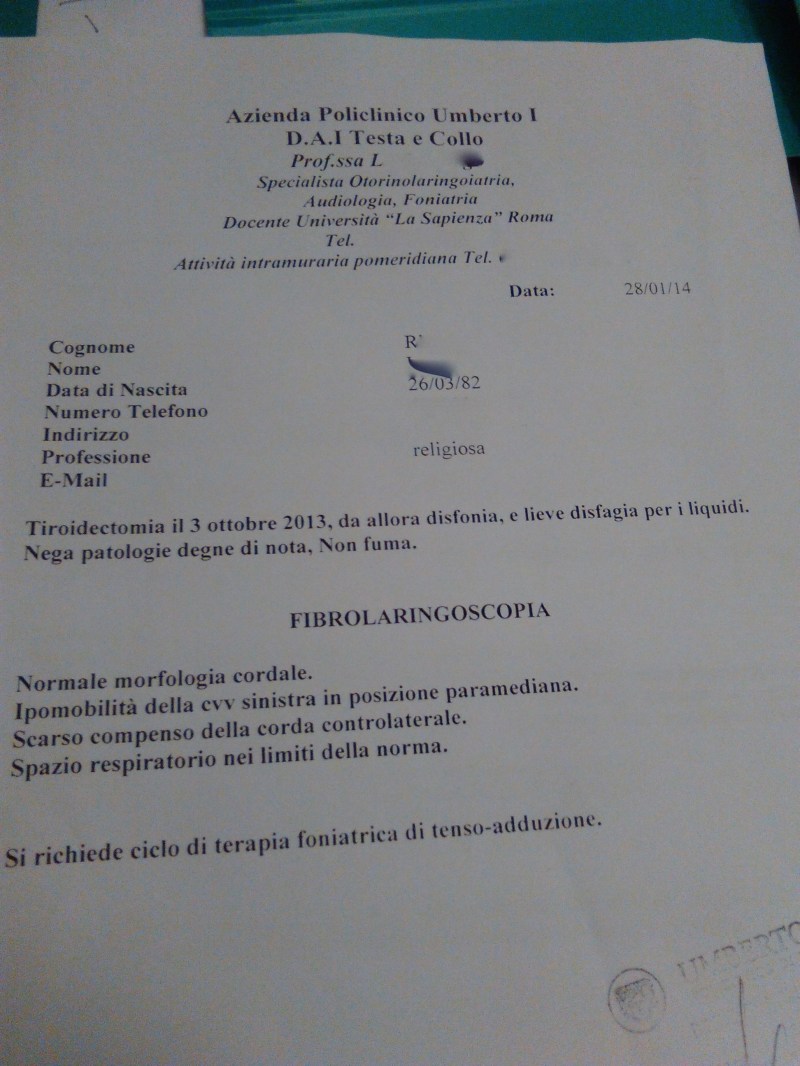
Sister I. entered my study program in june 2014. Sister I. had an important surgery to save her life, a thyroidectomy in october 2013. After she had problems with the voice, she could not easily speak, singing impossible. She used to sing in her convent, many times every day and also as a soloist. She had a beautiful clear and natural voice, not trained and had some stuttering when child. She had calcium levels very low and they remained low durign the program and after. Now she sings again and as soloist as if she had never had any voice problem.
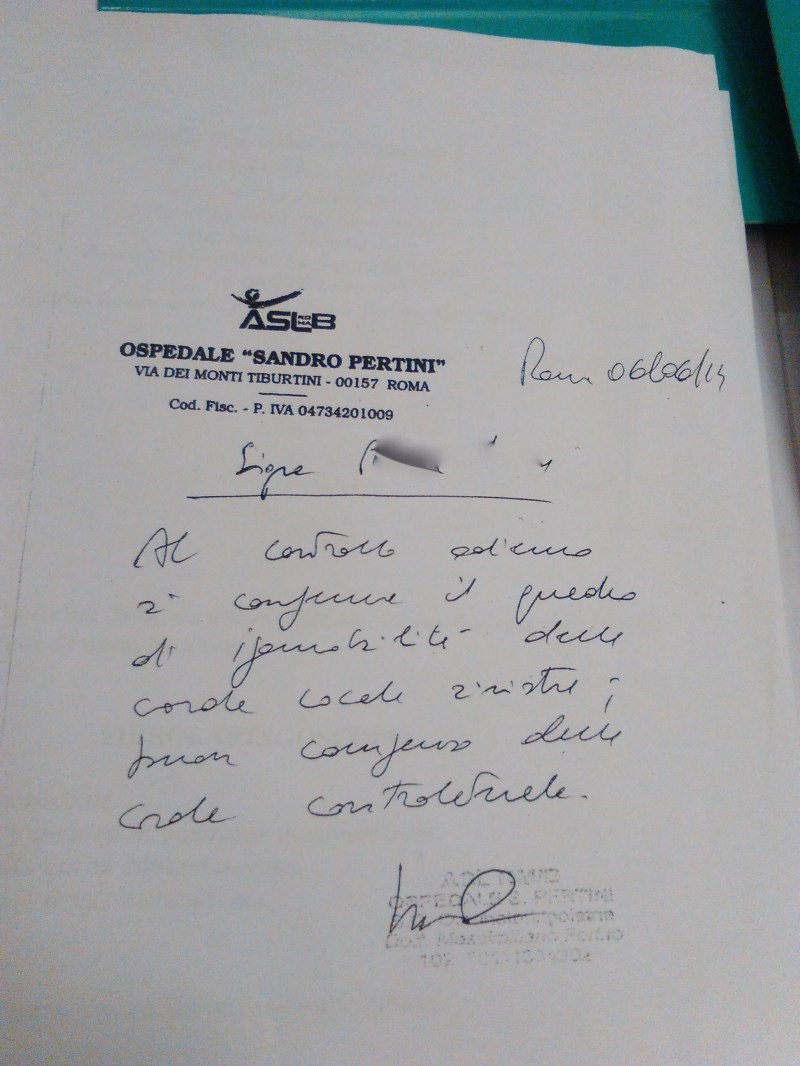
Here the certificates with the diagnosis of hypomotility of the left vocal fold before logopedic treatment and still the same hypomotility after but but a good compensation gained, singing still impossible for her.
*01/28/2014 Tyrodectomy on october the 3rd 2013, since dysphonia, and slight dysphagia for liquids. Negate having other noteworthy patologies.
Fibrolaringoscopie: Normal cordal morfology. Hypomotility of left vocal fold. Inadequate compensation of the contralateral fold. Normal respiratory spaces. No smoking. Require a tenseabductive phoniatric treatment.
After logopedy * 06/06/2014 At current control it is confirmed the situation of hypomotility of the left vocal fold, good compensation of contralateral fold
It confirms the hypomotility of the left vocal folds but now a good compensation of the other side. She had very low calcium level from the operation till several months after the last certificate you found at the end.
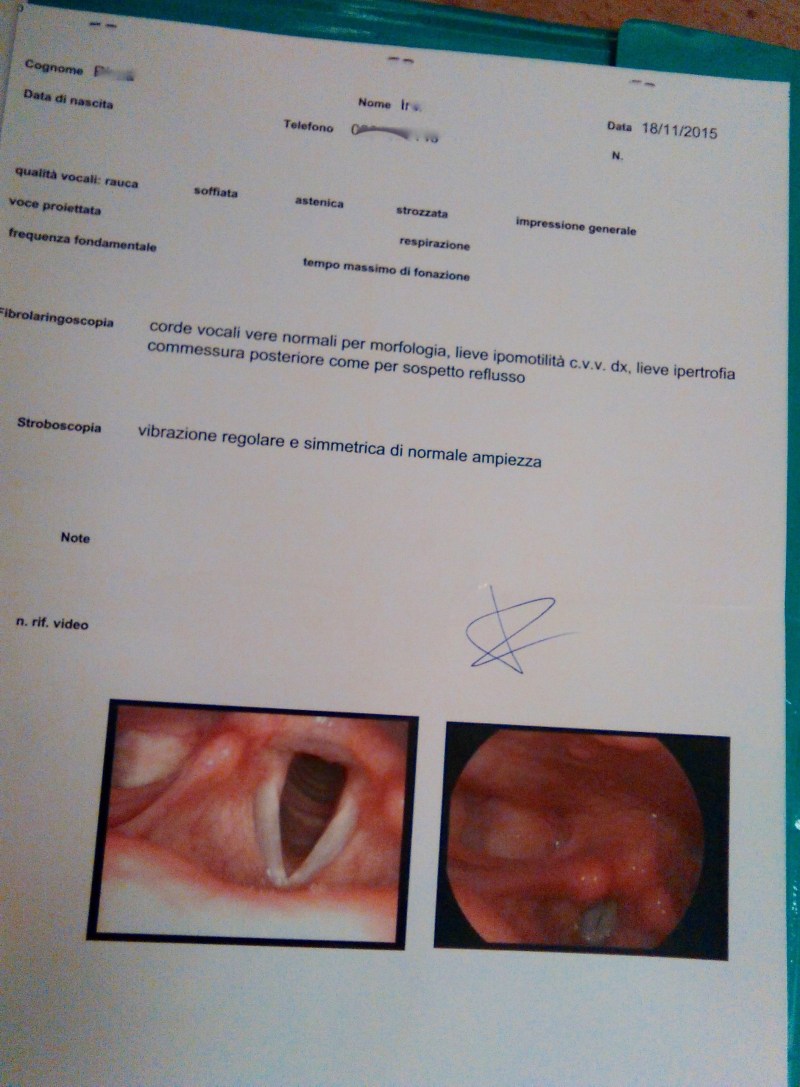
After #cossuprogram. During she could get back singing every day and in some Those are her vocal folds in photo and stroboscopy after nine months since we stopped our work. No maintainance exercises, no further therapies. As nothing has never happened to the left fold. The certificate confirms that
* Fiber optic laryngoscopy: True vocal folds normal in morphology, slight hypomotility of the right vocal folds, slight hypertrophy in the posterior closure as for suspected reflux. Stroboscopy: regular vibration, simmetrical and of normal amplitude.
And since our work Sister I. sings every day and again as a soloist as before the surgery. In may 2017 Sister I. wrote me that she had been the soloist of the Litany of the Saints during a Solemn Profession in the Basilique of Santa Maria degli Angeli in Porziuncola (Assisi). As nothing never happened to her left vocal fold, joy.
We could make the left fold work again after three weeks and in the video is her voice the first meeting and after 5 weeks. Professionals will hear that there is a substantial difference, even if in a subtle way since it has to get some training back after one year and a half of hypomotility. You can hear the gain in the ring, a little glow on the sound, a more clear timbre that starts appearing. This to me is a truly important sign and telling me that the vocal folds start having a correct activity, I know it is the start of having after just to make the chord being trained. She could sing in a little celebration of Sandro Pertini Hospital one month after the end of the program.
My students’ Recital 3rd part
On 14th July 2016 my class sung in the recital for the end of the lessons. Rita Negrini opens the recital with Amy Winehouse Back to black.
And then she sings La notte
#cossuprogram third case M. 7 years old
M. is a 7 years old boy who entered my three months study program.
Those are his vocal folds in November 2015 and a week before we started my program. Kissing nodules, hematoma, deeply dysphonic, with also a problem of stuttering; three years of logopedic treatment with no significant results.


In the video shown below his sound at our third meeting and after a couple of months. At the end of the video you can hear him one year after the end of our work that give an idea of his speaking voice and the clearness he reached with no further exercises (it is usual in my experience that when we correct the vocal gesture the sound will have a year to really change in timbre and density).
- He was a very difficult student and not for the age; he had a not collaborative attitude, I thought that the difficulty in not feeling of having a voice to express himself for such a long time could had some responsibility in this attitude, but as you have seen the program worked even if he never made an exercise at home and the sessions were half long the others. Since he felt less difficulty he tried to totally stops collaborating and never made an exercise at home. At the end it have been impossible to make the videostroboscopy, the previous ones were easy and not a problem. At the end of the three months program the stuttering was reduced to a third of what was before, I worked on a physical part that came from a not connected muscular chain that I found related to voice production and the blocking in voice attack were reduced. Also some fear and anxiety I felt in him towards the speech failure was reduced and not felt as preminent, as before our work, he truly enjoyed his theatre performance at school and said his phrases with no problems. You can see that the singing sound is not really good (but to reach a very good sound it is requiered a longer time since in my experience for another year you hear the sound of how vocal folds have been treated previously and then their proper sound really appear), but you start hearing the different registers and the copertura and vocal abduction instead of air and that the singing order is simple and direct as in not patological voices. The speaking voice is clear and easy. Enjoy a little boy who can speak with less fear of failure, enjoy his theatre course and sing with great margin of improvement. And after one year he is stable and still gaining ring and round in the voice.
My students’ Recital 4th part
The closing songs of the recital: Rita Negrini sings Pink’s Who knew and Camilla Calling you from the movie Bagdad Cafè. Enjoy!
My students’ Recital 1rst part
Camilla is 17 years old and we started our lessons on January 2016. I am her very first voice teacher. This is her in the recital of 14th July 2016: Dolly Parton’s Jolene , Burt Bacharach’s I say a little prayer for you and Walk on by, Calling you from the movie Bagdad Café. Enjoy.
Basics Larynx height
Often it is said that the larynx has to be low; and in my experience this is often a misunderstood concept. In the high notes it has to be high enough to be correct for their production. There is a range of movement that is correct for voices and notes production and it is in this range that we have to manage its movement. Tha larynx has to be in that range for every note, just lowering in the moment of voice production. To have in all the extension an innatural low larynx will create more problems then it solves, and will need an exaggerate need of pressure that can be accepted and desired only for the last notes of each tessitura or in certain cases of belting. The larynx will come up and down in a controlled way along the tessitura, just it will lower a bit in the correct attack.
#cossuprogram first case
She is a singer who entered my study program in may 2014 with nodules, a pre-contact, an emathoma and a whiplash injury on the vocal folds. She had several years of voice lessons without gaining enough extension or intonation or the personal style she desired for a proficuous career. All the attempts to have a good technique (even with good and experienced teachers) were a failure, gaining something at the depens of other things and her vocal folds getting worse. This were her vocal folds when she started the program.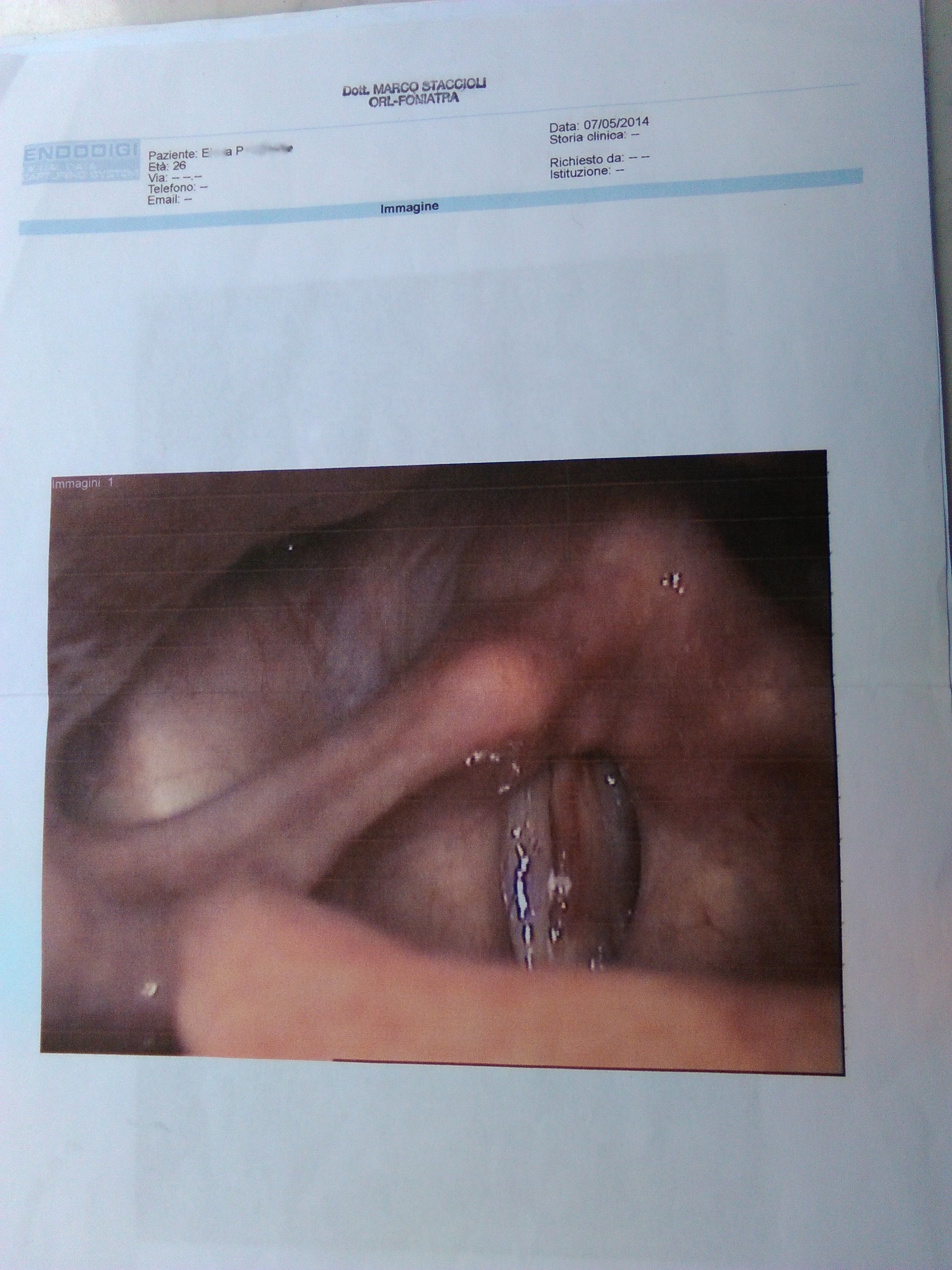
I found in her something in the muscular chains (that are the center of my method) without the sufficient elasticity and the proper work to give freedom and movement to tongue and larynx. The first weeks I used the physical exercises I have invented to start solving that muscular problem. As the connection was possible and more correct I worked on changing habits in authomatic gesture, imagined gesture and the feedbacks with vocalises on two octaves and songs out of her repertoire useful for my purposes. Those are her vocal folds after two months, quiet a huge difference.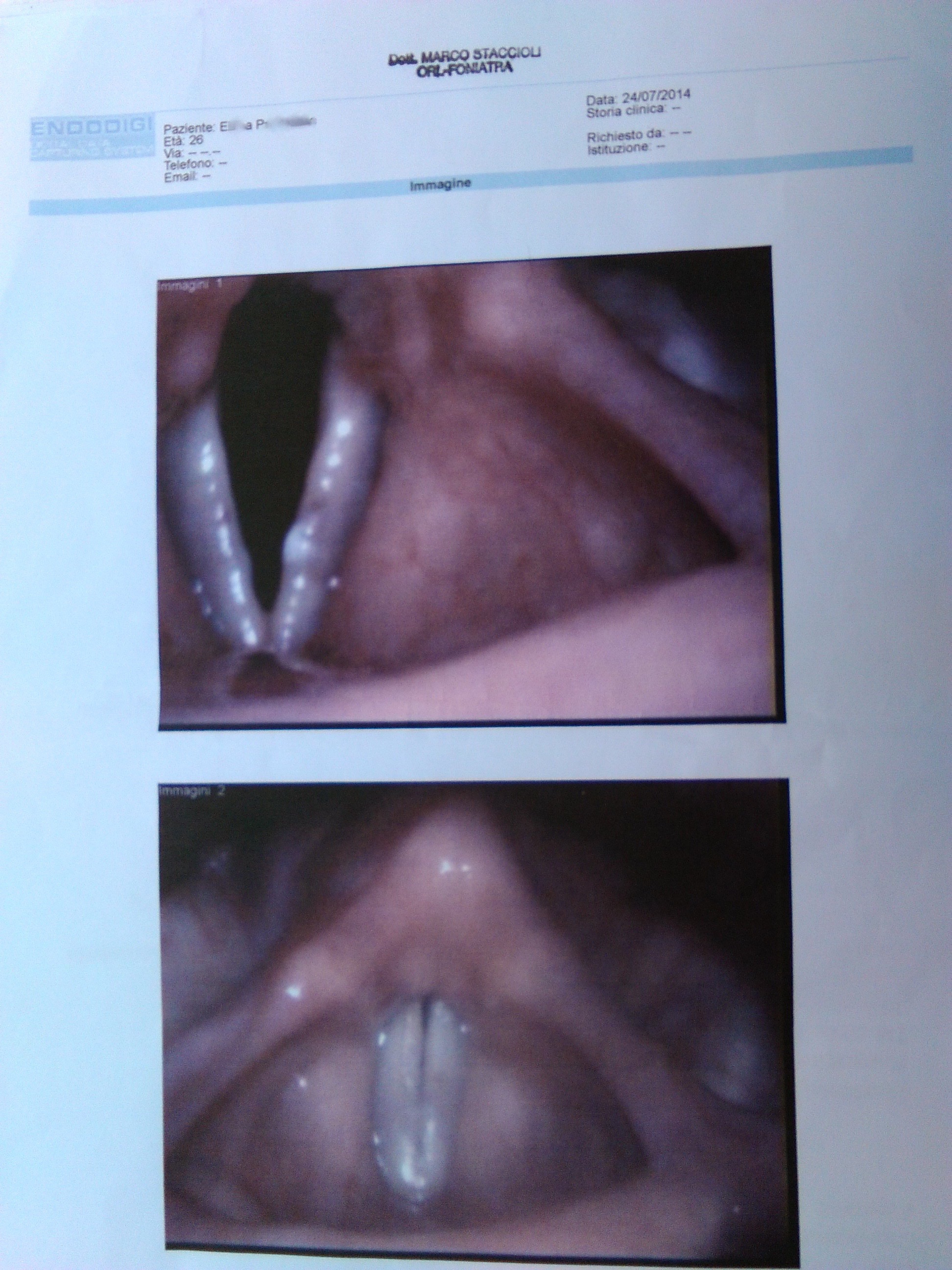
Here her vocal chords after one year (you find them also at the half in the video above).

