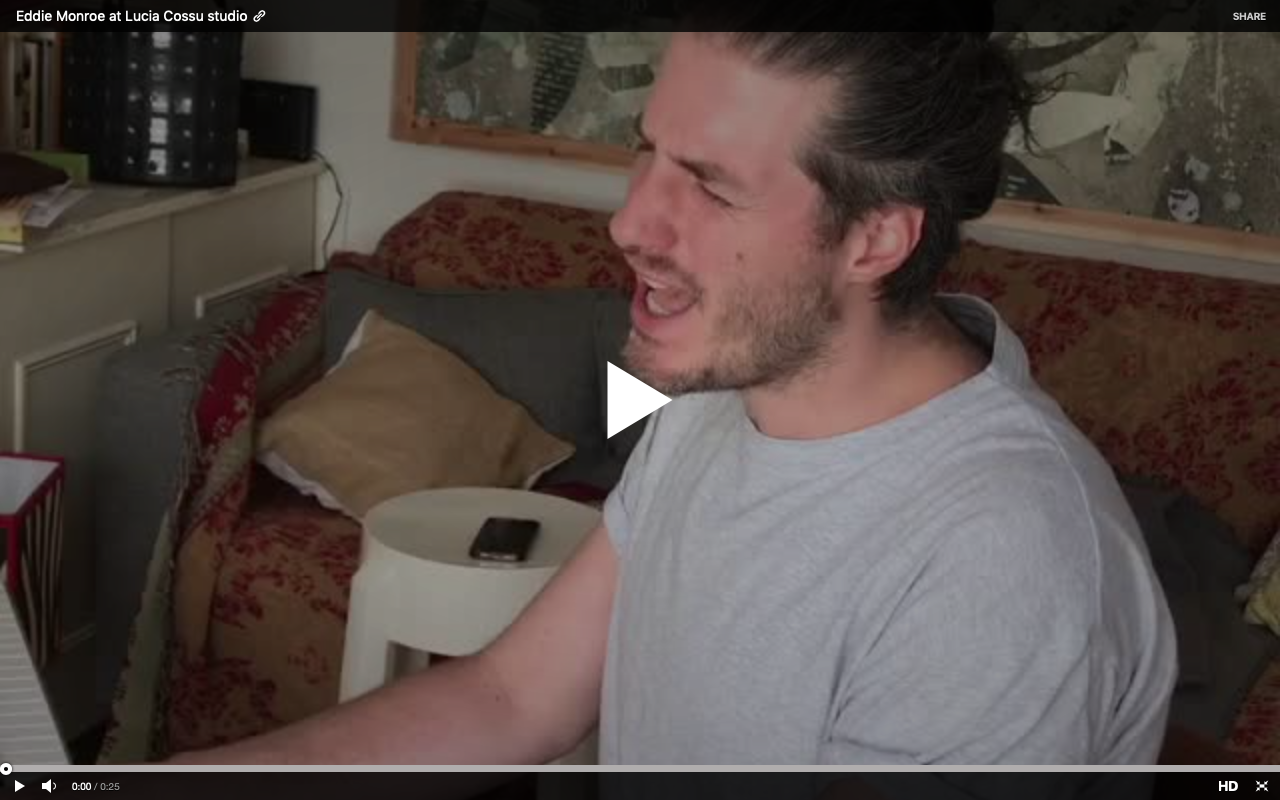
A typical exemple of a long work. Here 16, she has studied with me for 6 years. This was in 2015. Great personality, more jazzy than what she thinks of herself. Here some covers and one of her original songs. Enjoy.
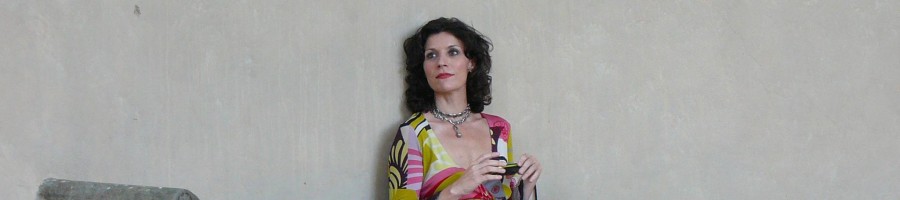
Lucia Cossu vocal technique and breath expert
Italian belcanto technique, Cossu method
A typical exemple of a long work. Here 16, she has studied with me for 6 years. This was in 2015. Great personality, more jazzy than what she thinks of herself. Here some covers and one of her original songs. Enjoy.
Arriva un possibile nuovo allievo. Può essere un professionista o un principiante. Prima cosa trovare il modo di metterlo a proprio agio per ottenere di ascoltarlo cantare come fa abitualmente. Seconda cosa è trattenersi dal pensare e capire e analizzare tutto subito, delle volte può essere corretta e completa la prima analisi ma in genere son le proprie cornici e categorie mentali, di gusto e tecniche a posizionarlo velocemente all’interno di esse tagliando, tralasciando e subendo anche l’ovvia reazione affascinata o infastidita di cose proposte e ottenute e fatte con un diverso settaggio e utilizzo nel sistema complesso canto. Terzo: se delle cose funzionano anche se non si capisce come e perché avere molta cura che l’insegnamento delle altre non le vanifichi. Quarto: chiedersi come essere un utile strumento per il cantante che abbiamo di fronte e non farlo rientrare in un’ideologia accademica, per quanto buona annullerebbe le differenze e uniformerebbe appiattendo verso il basso la vera tecnica che è sempre leggermente diversa su persone e anime diverse. Quinto: chiedersi regolarmente se si sta sbagliando tutto e far mente locale a dei test che facciano capire se si ha ancora un’idea fresca e vispamente utile invece che solo una strada che va in un punto deciso tempo prima e che va ricorretta o almeno ricontrollata come se fosse nuova man mano che ci si sposta dal punto del controllo precedente. Il canto si giudica dal canto e non da idee di come si fa, altrimenti Gould e Richter e Backhaus avrebbero dovuto avere la stessa proporzionale altezza del panchetto e Hari Hoenig non dovrebbe esistere. Sesto: ricordarsi che la tecnica vocale serve per ottenere musica e risultati musicali efficaci senza danneggiarsi e questo è possibile farlo con infinite varianti di cose simili e che il nostro è uno strumento complessissimo e nessuno di noi lo capisce tutto e fino in fondo.
Diaframma: l’unica respirazione che non è diaframmatica è l’assenza di respirazione. Se il diaframma non lavora siamo morti. Ci son modalità di lavoro del diaframma che presentano storture di vario tipo e praticamente un solo modo di averlo che lavori in modo davvero corretto e non è detto che solo se è del tutto corretto sia possibile un buon gesto vocale, che può essere presente anche se il lavoro del diaframma non è ciò che in teoria denota un respiro perfetto. Certe deformazioni impediscono l’utilizzazione degli strumenti del cantante, di cui il diaframma e il suoi agganci sono una parte, ma che non coincidono con il respiro automatico e il lavoro del diaframma stesso per respirare.
*All’interno di questi margini, allenamenti e utilizzazioni è buona parte della tecnica vocale. Io chiamo tecnica una maniera efficace, ripetibile e non dannosa di ottenere dei risultati musicali.
**Alcuni difetti che vanno corretti in alcuni in altri vanno ignorati o al massimo contenuti per non essere di impedimento, ma se fanno parte della ricerca espressiva e musicale e son parte della sua efficacia vanno il più possibile preservati.
*** Quest’ultima cosa anche detta: non tutti i settaggi devono essere uguali e non tutti devono cantare nello stesso modo.
Cantare è regolare un sistema complesso, e per sua natura funziona davvero quando si insegnano percorsi direttamente complessi per attivarlo e controllarlo. Questo desta la sensazione di casualità o magia che i non professionisti o i non davvero tecnici ritrovano nell’avere o meno voce.
Non è illogico o casuale, solo delicatamente complesso.Ciò non significa che non si curino aspetti singoli e parziali, con un lavoro mirato e precisissimo, ma ben distante e differente e non confondibile con il gesto complesso che si deve indurre a trovare.
E l’espressione indurre a trovare non è casuale o imprecisa, se si vuole un risultato davvero efficace non si devon dare appigli a gesti meno complessi, seppur paganti in un raggio di orizzonte breve.
La cosa rincuorante e che facilita molto il ritrovare il gesto complesso è che una volta indotto viene ricordato con una precisione e semplicità anche disarmante e il senso di piacere e benessere complessivo è tale da facilitare la sua riproposizione. Il cercare invece di prevedere e regolare in maniera solo volontaria e volontariamente direttamente indotta renderà impossibile il perfetto gesto complesso, facendo prevalere in maniera troppo squilibrata l’elemento che si crede indispensabile. Come per il vero inspiro, che ben ha definito e delimitato Ilse Middendorf, solo si può creare le condizioni per farlo avvenire (anche a piacimento e regolato precisamente per quando serve) mentre la parte volontaria dell’inspiro ne è complemento ma non parte fondante. In questo senso di ricerca volontaria e controllo tramite vie tanto indirette da sembrar al principiante casuali o frutto di abbandono dell’obiettivo è una parte fondante del gesto vocale efficace e musicalmente rilevante.
A.A.A.: reclutamento di persone per uno studio scientifico sul lavoro tecnico che svolgo su certe muscolature nelle mie lezioni di canto e i risultati che ritrovo costantemente. Lo studio è condotto in collaborazione con un foniatra e un osteopata.
Consiste nel fare un paio di lezioni a settimana di canto per tre mesi, riprese video delle stesse, controllo foniatrico e osteopatico regolare, accettazione della liberatoria al loro utilizzo per fini pedagogici e scientifici, impegno a non saltare le lezioni e a svolgere gli eventuali esercizi richiesti (per un massimo di 15 minuti al giorno).
Tipologie richieste: età compresa tra i 10 e i 55 anni, problemi vocali non di origine neurologica non risolti; cantanti professionisti con problemi da sforzo o di intonazione o non soddisfatti del tutto di quello che fanno; attori preparati vocalmente; stonati.
Lo studio si svolgerà a Roma, sarà completamente gratuito (ovviamente) e avrà una sede a Roma nord, una a Roma centro e una a Roma sud e dovrebbe svolgersi a breve, secondo caledari concordati con i partecipanti. Il numero non sarà altissimo e cerco tre categorie precise, per cui dovrò fare una selezione.
Per contattarmi
mail: luciacossu@rocketmail.com
skype: lucia…cossu
LILLI LEHMANN: SINGING TOWARD THE NOSE. HEAD VOICE
When the peak of the softest part of the palate is placed forward toward the nose, instead of being drawn up high behind the nose, as in the head voice (see plate, head voice and nasal tone), it forms a kind of nasal production which, as I have already said, cannot be studied enough, because it produces very noble tonal effects and extraordinary connections. It ought always to be employed. By it is effected the connection of tones with eachother, from the front teeth back to a point under the nose; from the lower middle tones to the head tones. In truth, all the benefit of tonal connection depends upon this portion of the soft palate; that is, upon its conscious employment.
This is all that singers mean when they[Pg 79] speak of “nasal singing”—really only singing toward the nose. The soft palate placed toward the nose offers a resonating surface for the tone.
The reason why teachers tell their pupils so little of this is that many singers are quite ignorant of what nasal singing means, and are tormented by the idea of “singing toward the nose,” when by chance they hear something about it. They generally regard the voice as one complete organ acting by itself, which is once for all what it is. What can be made of it through knowledge of the functions of all the coöperating organs they know nothing of.
Blind voices are often caused by the exaggerated practice of closing off the throat too tightly from the head cavities; that is, drawing the pillars of the fauces too far toward the wall of the throat. The large resonating chamber thus formed yields tones that are powerful close at hand, but they do not carry, because they are poor in overtones.[Pg 80] The mistake consists in the practice of stretching the pillars too widely in the higher vocal ranges, also. In proportion as the pillars are extended, the breath spreads over the entire palate, instead of being concentrated on only one point of it, and bringing at the same time the resonance of the head cavities into play. The soft palate must first be drawn up to, then behind, the nose, and the attack of the higher tones be transferred thither. The pillars of the fauces must necessarily be relaxed by this action of the soft palate. Thereby breath is introduced into the cavities of the head to form the overtones, which contribute brilliancy and freshness to the voice.
Many singers persist in the bad habit here described, as long as nature can endure it; in the course of time, however, even with the most powerful physiques, they will begin to sing noticeably flat; with less powerful, the fatal tremolo will make its appearance, which results in the ruin of so many singers.
If you find in a guitar dismantled, some piece unglued, some screw too tightly fastened, the strings not properly fixed do you expect it to sound well? do you think to play it? Are you surprised if it doesn’t sound properly? And if you have never played a violin do you find correct to judge your ear and musical capacity by playing it? Voices are like those two examples. Even when you don’t see anybody walking with his head in his hand or a leg round his neck, this doesn’t mean that his body is properly assembled to sing, or according to the second example he does naturally good and proper things to play his instrument. Some very lucky are yet properly settled and do some very right things just naturally, others not, sometimes due to simple injuries or bad habits.The worse is the judgement deaf-tone voices; I have experimented people who have submitted to, and the consequent shyness that render them more shy and uneasy in the regard of such a joyous instrument as voice is, and the consequent lack of the necessary energy and body attitude added to the problems that renders those voices out of pitch. Sometimes they also think having a bad ear and a bad musical brain. It is always possible but in my experience it had no relationship with a tone deaf voice. Tone deaf voices I have worked with, were mostly a bad shaping body, as the first example and when we properly set up they were no more tone-deaf voices, but only voices who had to learn how to sing. Some, very few in the second. To start with the ones of the first example I usually put them in a possible shape for singing (I explain that hereinafter) and I don’t ask them to match a pitch, but just to imitate me. If I put them in the condition of vibrating and I produce a good sound for them by passive attitude they will start vibrate according to one of the overtones in my sound, if possible to their body the easiest one, the correct pitch I wanted, if yet impossible something normally not that far in very little time. To make it possible there are many simple and less simple exercises to give the minimal elasticity and shape of a possible correct sound. I have to play them for the first period as the second range strings of a viola d’amore. The Viola d’amore was an ancient viola with a double range of strings, one under the other. The player played the upper range and the other vibrated according to the superior “per simpatia” was said, by sympathy. What is nice in that passive way is that the lack of tension to match a pitch will live the body smooth enough to simply let itself being changed and shaped by the teacher and vibrate. In that way they have the experience in the body of a sound less incorrect, a feeling to remember, a feeling to relate to look for sounds and pitches, a feeling and an experience that will feed body and brain and give a quiet and easy sense of comfort while producing sounds. The body and the brain will remember those feelings and will reproduce the same patterns while you will play less and less for what is acquired and as before to obtain more difficult and complex things. The teacher has the necessity to understand well the inside shaping of the student. What renders so difficult to understand what and how is badly set up is the fact that we don’t see the elements of our instrument, they are for the most part inside and very rarely we can feel it before having made a work on them, so how can a teacher know what to do? And how to do if the person doesn’t even feel the existence of he has to move and change? A good teacher and a good singer should be able to feel in himself what is happening in the student, but I think that on that subject the teaching world should think about developing proper methodic to deal with, and that’s why I talk about voice luthiery, a field to explore and develop. I can usually feel how they are shaping themselves, because I let my body being guided by their shape and opening the same communicative channel of musicians I can make them take the shape I am assuming. This shape I assume and want them to imitate must be not that far from the shape they have and at the same time they must have the elasticity to assume it. I mean that I have to assume me their shape and then to ameliorate it in a suitable way. To give them the elasticity I make them do some simple and less simple physical exercises. To maintain that elasticity and not make an intellectual control that will use movement pattern yet existing and not useful I ask them to lay together as children: I do they do, I do they imitate without thinking or analyzing my voice or sound or movement. When we think I experienced that some part of the body will get stiff and than it will be impossible to sing correctly without being yet nearly a singer. We can think before and after, not during.The exercises I give to the student will give the correct shape and strength or the necessary soft to all the body’s parties, and work on the coordination of the single parts. Singing is a complexe activity and we just have to render the brain and body in the possibility to execute that complexe coordination.
What is breathing for singing? What is correct breathing? Is it different from normal correct breathing? What are the muscles related? Which muscles have we to work to obtain a good singing breath?
The ancient methods talk about an appoggio (a sort of stand, of pillar) the voice find in a correct breath and of floating on the breath, of singing on the soffio (a gentle, very gentle blow) of the breathing. When we do sing well we lose the exact perception of the air going out and we just perceive a sound around us and a sort of lightness mixed to a sense of solidity and that’s what we call appoggio. How can we find appoggio? This is one of the most important questions of singing. It is normally the result of a good technique work, and it is essential to have the pressure without effort to make the vocal folds work properly. It is in some sort the way to make air become sound and energy, and not a rough blowing air. I tell my students to imagine that with appoggio air becomes water, a living water on which we surf. A sea or a lake or an ocean, it depends on the music we are singing, but not a geyser going out but something that become elastic on which we can float and jump and play surfing on the waves. It is a sort of pressure the air will have under the larynx that you will not feel as a pressure in a water gun for garden ready to be open, but just a freedom and a consistence in the body. This because we can augment the pressure by breathing out the air or by creating an opposition between the muscles of expiration and those which provoke inspiration. In the first case we will have not a good air for singing while in the second case all our air will become ready to become just sound and not to be rough to our larynx or vocal folds. I found very useful the osteopathic conception of breathing which is not that far from yoga conception (the true things relate all to the same, just the use or the path to join those is different). To osteopathy we have three horizontal structures involved in breathing: one under clavicular, the proper diaphragm and the pelvic diaphragm. Those horizontal structures in a good respiration move accorded one to the other. The clavicular for the voice is involved in the throat opening (also Jerzy Grotowski found that evidence in his acting technique), the proper diaphragm goes up and down in exhalation and inhalation, and it is just involuntary as the hearth. The pelvic one is composed by muscles that make lateral and backward-forward movement. A great part of singing technique is related to the possibility in controlling the diaphragm by the structures to which is anchored, and many are absolutely useful and good for many purposes. The new step I found in my experience is to control the effort and the wrong attack of sound by the training or retraining of pelvic diaphragm, which is directly related to the proper diaphragm. We can have easy pressure by opposing voluntarily the inspiratory muscles of pelvic diaphragm during phonation. I found very healthy to coordinate sound attack to a muscular inspiration through some studied movements that will have the result of an opposition of inspiratory and expiratory forces and a phonation with no effort. When this opposition is present the voice has the appoggio. With this simple appoggio and without a voluntary use of all the sustain muscles normally used in vocal technique in my experience I find an easy elastic voice that permits to work on faulty coordination of others part of the instrument voice. For a performing voice it will lack of some support sometimes, but it will be easy to add it when the fundamental defaults are extinguished and the gain in term of capacity of shaping new coordination is quite relevant. In a not so faulty voice I will add the necessary support by appropriate vocalisation and by appropriate repertoire. I usually wait the moment in which the attack of the sound has joined a good automatic coordination so to seem totally natural to teach the voluntary supports to obtain a voluntary work on sound more refined. The pelvic diaphragm often is not properly working and I have developed many exercises to work it and relate it to the voice, exercise anybody of any age can do. Results have been surprising also to me in profesional singers with or without problems, in some damaged vocal folds, in adolescents during the changing of the voice.
I often work with young and very young singers, some of them with genuine attitude and powerfully talented. I just teach singing and not music for young age, so the minimum I require is to verify in the first weeks the authentic desire of learning that only can make them be happy in short or less short vocal lessons, without wasting time and parent’s money. When they are very talented they desire to feed that talent with good music and after a little also to give that music to someone in the form of performance. I am not totally against young in performances, broadcastings and competitions, but there are some rules that I find important in all my teaching that should be followed and I see that often are not. All the talented persons I have met of young age showed a double in them: a young person and that talent that when real is out of age. The talent is adult and experimented, not the person who contains that talent. Talent has some necessities that can be very light to the talented and forced requests to the other. I think that nothing is bad if we just don’t hide young singers performances, if we let a space of existence to the characteristics of young persons. In my experience their performances are plenty of fluctuation in the level, in the technique control and in the musical depth. If we want to moderate that before their experienced technique make that fluctuation so little that you don’t really perceive it you will make of them little robot performers and that is what I really can’t bear. I can’t bear to see a little singer having the pressure of making a good performance for a tv public or to make happy people around him and not simply a gentle and respectful way to share and rejoice the music that this little singer desires to give us. Music is giving something to the others in a form correct and acceptable, since when this is possible by the technique level I agree and organize for my students to perform in private or less private or public situations, but always, and I mean always respecting the freedom of being just what they are at that moment, with their qualities and lacks. We are teachers in a path to help them become in the time musicians if they will desire that and if they have the talent to, or simply to enjoy and practice music with correct basis, not teachers who have to show their good teaching by the incredible performances of little robots performers. We have to help them to make and experiment and refine the music they have inside, not to use it for our pleasure or business, and the difference is clear and sometimes very subtle. You will never find before the correct time one of my student required to be “perfect”, they will always have from me the request to have the courage of having the pleasure of performing and the courage of trying what the inside is asking to have music, and after we will discuss and choose what was good, healthy, not too plenty of risk but in their sense of their imagination, of their musical universe, of their musical dream. The level is something that raise all together when it is well conducted, and can be so easy to make one perfect or two perfect songs during one year, but that will not raise the entire level in a balanced and grounded way. I teach to beginners and they have the right to be what they are during the time they get stronger and more solid and stable in their results, and no tv Show or Competition or parent or manger should put the pressure on them of not being enough or to have to do something far from their genuine talent just to make someone happy of them.
The same is to to be said on the vocal performance and the risk of abusing so young instruments: they are growing and they are elastic and not strongly structured instruments. We learn adults not to do everything is possible for our voice to do, we must be much more careful to teach what is healthy and what at a certain age never must be allowed. Sometimes they find by themselves some high tones and too heavy notes that make everybody around them being excited, but in that we have to teach them well what can be done without risking the future of their voice and what will make it age prematurely and ruin it. When they are young they are often less protective toward themselves as adult are and I prefer not to teach what can be dangerous to be sure they will not use when nobody controls or just to be appreciated and loved. But young voice is then another subject.

