Good technical work with Eddie, wow he truly follows me and in short months! I have been kind and tough, truly tough where required on some old bad habits. Bad habits have a special place in my work because they have a bad order in the brain and a great part of our work is to solve bad roots that you pay too much. He trusted and followed me and now he is ready for his beautiful original songs in a great discographic project, a project born on his songs and voice just started bewteen London, Sicily and New York and produced by a producer to be happy. To me he is still a bit too high in the larynx but it is justy a question of time and of stamina to gain in the connection, but yes truly good work. What a pleasure and honour to be the vocal reference for those artists who arrive to me.
Author: Lucia Cossu voice teacher
Voice teacher/ singing teacher pro/future pro all styles.
🌏online; former classical soloist, pioneering bridging biomechanics& voice practices, international presenter.
.
Italian/French voice teacher for professionals and future pro singers, innovator in vocal technique specialised in training and personalised solutions, voice development and voice preparation for touring/recording, young voices development without forcing the delicate and respectful balance of young talents. She has solved strain/issues and limitations of singers unsolvable by training or medical therapies. Those skills have 15 years of successful career and voice transformations in all styles; hospitals have sent her some desperate cases, all successfully.
Her innovative perspective has been presented at the prestigious Pan-European Voice Conference PEVoC14 2022 in one paper and two workshops and three Posters at The Voice Foundation 52nd Annual Symposium May 31- June 4 2023 in Philadelphia, where she will present again in 2024 an oral presentation and two more Posters and at PEVoC15 with another oral presentation plus two workshops.
She comes from an international soloist career in classical music that a malpractice during an abdominal surgery has interrupted (the surgeon has been convicted).
Courses and workshops are available online from everywhere and in person can be arranged.
My artists: Margherita Rinaldi
Matt Bianco spirit and sophisticated atmosphere are back, and they are Italians and I have the great pleasure and honour to work technically with her. Margherita Rinaldi album release, enjoy the new video of Brand new day.
Fundamentals A delicate matter in the newness of my work.
One of the central questions that my work poses in its results is that some excellent musicians and singers previously hidden into a not responding correctly singing body (also for many long years), can now correct this substantial deformation and achieve a correct and effective vocal gesture. Is it then all solved? Is it then that they have just to sing and use new gesture and get what they did not previously? Would truly like it was just like that; I would really like and love it for them but no, there is then a hidden trick to be solved and not easy to accept. We have to deal about the fact that with an ineffective gesture the feedbacks were affected at all levels, also at internal levels. So you give someone a winner gesture and if you do not work at the same time on internal winner patterns not experienced previously you will have a loser attitude and mentality into a now winner gesture. If instead you train at the same time vocal pattern and internal pattern you can give the opportunity to change and obtain at the same time winner attitude and winner gesture. For a technical and a personal point can be perceived as rough to accept that to a loser gesture (just an objectively not effective vocal gesture) correspond a loser way of deciding and of being toward voice, but you can as coach give reason and dignity and make it indipendent from the arrival point of someone but just as a not lucky point workable and changeable. All the singers I worked with who had vocal issues in some sort were also internally affected by that, the good and fantastic news is that yes they totally surmounted that nearly all and became winner, and this is the reason why I do not follow those who tell me to choose only yet winners.
Tips
Tips. The chimera of the opposition of depth versus futile, depends how.
We hear sometimes talking about the need of deep and of a connection to what is the no time and where everything is the same to everybody. I also work to obtain this connection with my artists, in some of my posts you can find the question even if said in other terms. Does this mean that we have no place and we give no place to futile and superficial as some seem to deduce as if or one or the other? There lies an important point: we need both and the misunderstanding lies only in how obtaining both correctly. Put in your training deep and consistency and that precise and nearly hurting serious concentration to find inside and as the structural root of your sound and breath this one who is the same for everybody, then go on stage and be futile, react to superficial, to the sun, fall in love with musicians and sound engineer and how he is playing with your sound, push the groove of those breezes nice that those feelings are, feel the root of the public but play with their outfits and make up. If trained on consistency no surface can take away the connection, but it will be possible fun and joy and poetry and dancing.
Tips. Technical voice towards natural voice.
Technical voice can support and give a sound to dreams and visions and a part of world and universe while the natural voice supports and give voice to the interpreter, his life, his habits, reactions in life and intuitions. Technical has a training to access to a freedom and reactivity that use the interpreter, through and beyond him and mixing him and the existing outside him.
(For technical I do not intend the declared technical voice, meaning by that an affectation in sound and artifice perceived in singing, this is a techical limit to be solved.)
It is a choice and not a sound, it is a way of being interpreters and artists.
Tips. When I make my students wait.
Sometimes, on purpose, I make my students wait. Can be just a couple of minutes, can be more, can be me opening the door with still my earphones, can be a not care about them for the time of finishing what I was doing.
They sometimes think I am losing time of their lesson, but I am teaching a lesson perhaps more important than some vocalizations. I teach them the offering and especially the concentration, that offering I talked about in a recent post. Their time for singing, their time in lessons, their time in rehearsals and on stage must be in the sense of this offering and of concentration to sing, and not judging and analysing and arguing and stating. It is not a requirement of humbleness or patience or submission, not at all but just the capacity to remain focused on the correct attitude to sing no matter disturbances or ego requests. I go on ’till they arrive not taking care of how me or a technical problem on stage will make them wait (sometimes in music even hours or not imagined sudden rushes), and remaining ready in any moment to do their job; and they learn to make a public wait the correct or musicians on stage or into the music, to obtain what is correct and has a greater sense than just a good voice in tune.
Fundamentals
Work on what you are, not on what you pretend to be. Perhaps the most tricky and delicate part of my job is obtaining that by my artists.
Fundamentals.
That difference not always perceived or made relevant but as subtle as corresponding to two total different universes hidden bewteen a request and an offer. Music is always in an offer, even when ruled and born by professionals requests. It is a level of choice and comprehension very important to an artist in every kind of point of his career to be effective.
Tips
Since your diaphragm (as many other things) is built on actions, act on your choices and purposes and not on your fears.
Fundamentals. Finding copertura and throat opening using Manuel Garcia
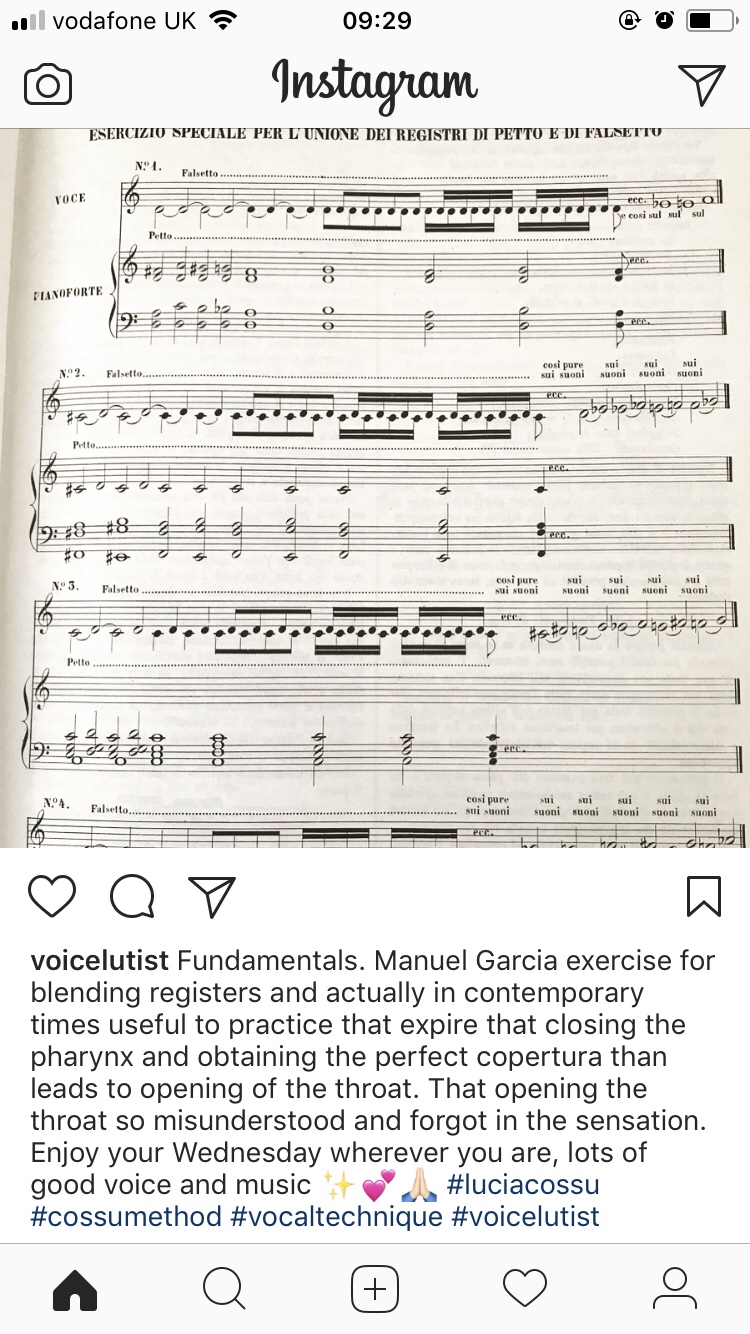
Fundamentals. Manuel Garcia exercise for blending registers and actually in contemporary times useful to practice that expire that closing the pharynx and obtaining the perfect copertura than leads to opening of the throat. That opening the throat so misunderstood and forgot in the sensation, yet fundamental for effect singing and to transform a flow of air into a not flowing air but just a force and no more air sensation. Copertura transforms our instrument from a ineffective flute to a violin, being breathing muscles the arch. Enjoy your Wednesday wherever you are, lots of good voice and music.
Fundamentals. Adapt to times changing.
Into expire lies inspire. The only question is how to work and treat expire, and adjourn this work on changings yet happened and preparing chagings happening.
Said in other terms you have the yin disclosure from a correct yang, at the end and as a part of a correct yang. To define and work on yang is the question now
* Ilse Middendorf worked very well to define what the yin was, looking for the definition of correct inspire. She took away totally the yang since she saw the prevalence of this into inspire and wanted to avoid the loss of the totally yin principle that is at the basis of inspire nature. Linklater has found back a yang but does start not from where has to, they are expire and inspire one into the other defined and separeted but not far. External muscles can make mixed actions, not the root.
** Manuel Garcia worked truly well on the expire pure and correct that has as a disclosure the opening of the throat that appears when diaphragm make an inspire without interrupting the sound. And the principle of Belcanto italian technique is to find the inspire from the expire. Correct expire is crucial, not being just a pushing of air.
Tips. Does vocal attack happen well by pushing out air?
Air is not the best way to start a wave. Sound is a wave in a fluid, a geyser is not the best way to obtain a wave from one or more oscillators. A best way is to make that air a wave itself and to transmit oscillations we want becoming a sound being transmitted to our entire body in homogeneous or dishomogeneous way. We will then obtain to have all our body becoming the true oscillator and this wave produced inside to transmit to air and bodies outside. You can still sing by air, you will have a poor singing.
Tips. Where a singer’s sound starts and from what.
What is it the voice sound? Does a voice sounds always the same and having always the same perception of physical work to start a sound?
Sound is a wave, starting from a vibrating source. A trained singer with his memory will have a complex reaction and he’ll have his body ready to make the note required and vocal folds vibrating, slightly before we put the energy and the mucosa wave that starts the sound heard outside (an experienced singer can prolonge this moment of singing without sound for quite a long time and it is something special to experience). Inside we have lots of other structures vibrating, we are not at the zero absolute point so everything in us ocillates, sometimes vibrating in accordance with something else outside transmitting the oscillation or determined by our specific inside or even a sum of both. A good point to start singing is to just give an internal movement to breath related structures so to have a clear sound coming from our instrument that is generally what is perceived as our voice. The interpreter will make you dream, and have all this incredible effects a voice can have, does not just listen to its vocal folds and big muscles vibrating the note but hears and chooses something more precise perceived inside or outside, and puts the wave starting from this other point of oscillation or its waves to reach it in a summable way so to sum it in his proper voice and so making heard what sometimes we call the invisible that become visible. Truest interpreter will sound on something they feel as something precious or significant or simply with an inexplicable charm vibrating somewhere and just making it being where the wave starts or arrives to give it a voice.
Vocal tips. The excess of ego.
My artists know well how I can be tough and not movable in asking them to solve together something that I call an ego excess and it is not the natural exaltation of ego on scene. What I talk about is the not solved ego that wants to state its existence all the time, especially under stress (we always sing under stress that you can also call energy). I will say something engineers can understand well: if you want to make some waves and not only turbulences and crushes you have to manage every source of oscillation and manage the waves produced. We have inside many sources of oscillations and we also react to those outside so we biologically and physically have many sources of waves. Voice production is according all the sources to manage and sum or to manage the waves produced internally to become a sound. An ego not solved states its existence making a fight and crushing everything not born from him, so fighting every wave or source it has not given precedent permission so it and it is just useless and not adapt to have a control. An ego solved will collaborate to manage and create and accord this sum of waves produced by all can react in a human. (Not to talk the obvious successive reacting and according with others musicians also producing waves, and further exalting or dialoging with every thing has an effect on stage 😉 )
* I do not mind egos, just care about voice production. ❤
Vocal tips. Same word same notes: exactly the same?
When it happens that you ask a young singer on the same word that the song repeat two times one after the other with the same notes to change slightly vocal position, so slightly not to be really clearly perceived in the throat and nearly seeming the dream of changing position, and a change in overtones appears, a light, a light into the word the second time, but not the first. And you have this movement of light that opens totally another consistence and horizon in the audience, as if the light of a precise nebulosa entered the song. And the singer looks at you without words, the same light in her eyes as she was audience. And she is nearly 15 and she hears that, and she understands, and she understands that you understand and hear too. And we both know that those are the reasons they call her to sing, the reasons she sings and thought happened by casualty sometimes, the reasons you made music your life and they can be dreamt and chased and fixed.
* the song was Safe and Sound from Hunger Games and the word was gone in the second Verse. Taylor Swift changed to change the sound, us to just have the same with this overtone that gave a sound into the note. The singer was MariaSofia Ferrante, not yet 15 then.
Songs the interpreter do not want to sing
She did not want to record this. We discussed a lot, her saying it did not represent her and that she wanted to to be represented by other songs, without yet realising that if she was pursuing a professional career it would be normal to sing some things not choosen by her. This scare of some interpreter is valid when they cannot choose nothing, but to have to sing a part of repertoire not choosen refine the interpreter personality and skills to be himself going more in the comprehension and depth of what he is, and also discover sides and shades not suspected. The result is pretty good and lol it is the song more played in her playlist. Enjoy!
Vocal tips
When my artists send to me something to hear in which they push intentions and do not find it in the voice. Very often they still think doing something on the moment to produce the note, they still think singing is when heard. Singing is doing some things with your body and your imagination and emotions put into the body, the sound heard will be just in certain moments as a part made heard of this doing and not a pressing all together just in the moment you want to produce a sound. You produce a sound and a phrase and a movement inside and you just make it heard on the outside: sometimes entirely, often just fragments of that.
A new born
Today the postman did bring a new born in which I have some responsibility. ❤
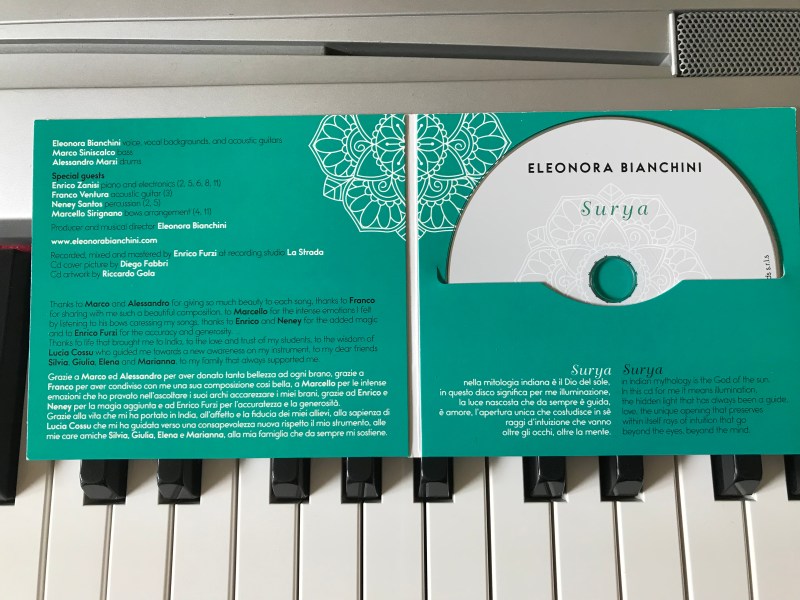
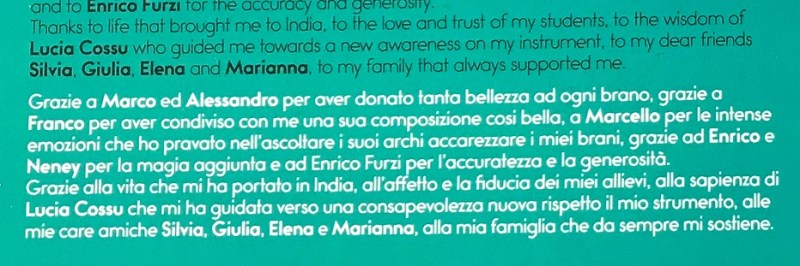 Dear Eleonora Bianchini, you thank me for my instrumental wisdom. ✨ I thank you for your music and the great joy of this technical path made together, and the total trust you had in letting me shape your muscles and coordination bringing your voice in an unknown land that now is home.
Good luck Surya, Eleonora Bianchini made some songs I would not forget.
Who am I
I am someone who can solve the reason why some people can’t be effective in a vocal technique or style, or when a professional can’t have the full or correct use of its instrument even with excellent teachers or coaches. I was a soloist and being trained in Italian Belcanto technique. A chronic disease that affects my inflammation level in the body related to a medical malpractice made my career last just three years during which I achieved goals I even had not dreamt about (further details https://luciacossu.com/about/).
I started then teaching, vocal technique. Being frustrated by seeing some structural issues that made some singers think about them and never relax into a deeper dialog with music I tried to found ways to solve them forever with the same approach to sound I had when I was a soloist. So I invented some physical exercises and discovered in what they were useful to a wider range of persons, even if invented on someone specific. This became a corpus of exercises, some totally invented by me, some are yoga or dance exercises modified to be useful for voice muscular chains. I have so found some principles to work on the reason why some can’t have a proper vocal technique even with good teachers. I found the relation voice-muscular chains in a way not imagined by professionals and now also the way some Manuel Garcia vocalises were intended and why even my excellent belcanto teachers couldn’t use them correctly. . It is a very specific work, nothing to do with others body practises for singers, useful but less precise for a vocal purpose. To be sure that the results with my students were really appropriate I put some people with and without vocal problems under medical control before and after our work together and it was confirmed the solution of their vocal problems in very short time, while a medical prevision of no improvement possible (https://luciacossu.com/cossu-method-program/ ) and those with no issues had confirmed an improvement in voice and posture.
When I say it is new I don’t mean that my work comes from nothing and goes to a new land, no. I mean that it is a step forward in what is the italian belcanto technique. I mean that it brings to the vocal land many that couldn’t previously reach it. And those who are yet there have a way to refine and obtain more.
That it is: a way to bring to voice (and voice styles and technique or even just natural voice) those who couldn’t before and to refine and find tools and expression for the advanced and the professionals.
It is a sort of way to put everybody to the zero point.

